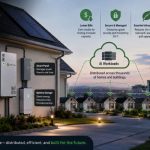
The AI boom is changing where computing lives. For years, the dominant model was simple: build a giant data center, secure enough power and water, and pack it with servers. That model is now running into delays, grid constraints, community opposition, and long interconnection timelines, which is why a new idea is gaining attention: distribute computing capacity across many smaller installations, including residential homes.
At the center of this shift is a surprising proposition: your house could become part of the cloud.
Startups such as Span are developing cabinet-sized or wall-mounted units that can be installed on homes or small commercial properties, often paired with smart panels and batteries, so unused electrical capacity becomes useful computing capacity. In some proposals, homeowners get reduced electricity and internet costs in exchange for hosting the equipment.
The appeal is practical. Large AI data centers can consume as much electricity as tens of thousands of households, and developers often face expensive upgrades to substations, transmission lines, and other grid infrastructure. By spreading workloads across thousands of homes that already have grid connections, companies hope to avoid some of those bottlenecks while getting computing capacity closer to where it is needed.
Why Huge Centers Face Pushback
The backlash against mega data centers is now a major part of the story. Communities have objected to rising electricity rates, heavy water use, environmental impacts, and the feeling that they are being asked to shoulder costs while outside companies take the upside. In one recent survey, seven in 10 Americans said they oppose building an AI data center in their local area.
That resistance has real consequences. Recent reporting says opponents blocked or delayed dozens of projects worth about $130 billion in just the first quarter of 2026, and active opposition groups have spread across nearly every state. Some states and localities have also introduced pauses or moratoriums on large data center permits, reflecting a broader political shift against unfettered growth.
Environmental concerns remain especially potent. Large data centers can require extensive cooling and significant water resources, and their power needs can intensify pressure on already strained grids. Critics argue that the jobs and tax revenue often do not match the scale of land, water, and infrastructure commitments, which makes the facilities a hard sell in many communities.
The result is a planning problem for the tech industry. If hyperscale campuses are increasingly difficult to site, finance, and permit, then smaller distributed systems become more attractive as a way to keep AI infrastructure expanding without triggering the same level of local resistance.
Piloting the Distributed AI Model with Residential Nodes
There is also a real estate angle. New housing developments are being tested as deployment sites, with some builders exploring nodes installed on exterior walls alongside normal home systems. The concept is designed to look more like a utility appliance than an industrial facility, which may make it easier to add capacity without the local backlash that often follows large data center construction.
For example, the distributed AI concept is a pilot idea from Span, Nvidia, and PulteGroup that would place small AI compute nodes at new homes instead of relying only on large centralized data centers. The pitch is that these “XFRA” units use spare residential electrical capacity, are installed during construction, and could be rolled out across many homes to form a shared distributed compute network.
PulteGroup has said the concept could give homeowners access to new technology and potential income or bill offsets, while also reducing strain on local infrastructure and preserving land for housing. Span has said it plans a 100-home proof of concept with PulteGroup and other builders, with an initial focus on new residential construction before any retrofit expansion.
In practical terms, the idea turns homes into small edge-compute sites that support AI workloads closer to where power and space are available. The key appeal is speed and flexibility: instead of waiting years for a giant data center campus, the capacity can be distributed across many sites already being built.
Risks And Tradeoffs
But the idea is not without tradeoffs. Residential compute turns private homes into part of commercial infrastructure, which raises questions about cybersecurity, privacy, liability, noise, maintenance, and what happens when equipment fails. Critics also point out that a distributed network of home nodes broadens the attack surface and relies on households that are not equipped like enterprise data centers.
Environmental claims are more nuanced than the marketing suggests. Supporters argue that using existing home electrical capacity can reduce the need for new land and large utility upgrades, and some systems even reuse waste heat for home heating. Still, the real climate impact will depend on how the electricity is sourced, how much backup infrastructure is needed, and whether the distributed model actually lowers total energy use or simply moves it around.
This trend suggests that data centers are becoming less like single buildings and more like a distributed utility. If this new approach is scaled, the result could reshape housing design, grid planning, and the economics of AI infrastructure.
It also shows how AI is pushing infrastructure into places people never expected. The neighborhood data center is no longer just a thought experiment; it is becoming a live test of whether homeowners will trade some control for lower bills and a role in the AI economy.
Jim has executive level experience on both the client and agency sides, with deep skills in strategic business positioning along with creation of hundreds of targeted content pieces. There’s nothing he likes more than mapping out the intersection of new disruptive technologies and their optimal market positioning.