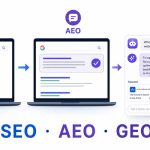
Online search is evolving fast. For years, brands focused almost entirely on SEO, or search engine optimization, to earn visibility in Google and other search engines. Now, as AI-powered search experiences become more common, two newer approaches have entered the conversation: AEO, or answer engine optimization, and GEO, or generative engine optimization.
At a high level, all three are about being discovered by the right audience. The difference is where that discovery happens and how success is measured. SEO helps you rank in traditional search results, AEO helps you become the direct answer, and GEO helps your content show up inside AI-generated responses.
SEO: Building visibility in search
SEO is the foundation. It focuses on helping your site rank in search engines for relevant queries, bringing in organic traffic from people actively looking for information, products, or services.
Good SEO still depends on the essentials: keyword research, useful content, technical performance, internal linking, and authority-building through backlinks and trust signals. While the tactics keep evolving, the goal remains the same — make it easy for search engines to understand your content and for users to find it.
Signs of SEO success
- Higher rankings for target keywords.
- More organic traffic.
- Better click-through rates.
- Stronger conversion rates from search visitors.
AEO: Earning the direct answer
AEO is about creating content that search engines and AI systems can surface as the answer to a user’s question. This matters for featured snippets, People Also Ask results, voice search, and AI-generated summaries.
The content that performs well in AEO usually follows a question-and-answer format. It gives a clear response early, uses clean structure, and avoids making readers dig through unnecessary text before they get what they need.
Signs of AEO success
- Featured snippet ownership.
- Visibility in AI Overviews or similar answer boxes.
- Presence in People Also Ask results.
- Traffic from question-based queries.
GEO: Being cited by generative AI
GEO is the newest concept of the three. It focuses on making content discoverable and usable by generative AI systems such as ChatGPT, Perplexity, Gemini, and others.
Instead of just ranking or answering a question directly, GEO is about being referenced, summarized, or cited inside an AI-generated response. That means content needs to be especially clear, well structured, and trustworthy. Strong topical authority, consistent entity signals, and factual accuracy all matter here.
Signs of GEO success
- Brand mentions in AI-generated answers.
- Citations or references to your content.
- Correct attribution of your brand or expertise.
- Visibility across multiple generative search tools.
A simple comparison
How to approach all three
The best strategy is not choosing one and ignoring the others. SEO remains the base layer because it helps people find your site in the first place. AEO extends that work by helping your content become the answer. GEO pushes visibility further by making your content useful to AI systems that generate answers on behalf of users.
A practical content strategy today should do three things at once:
- Answer the query clearly.
- Support the answer with structure and context.
- Build enough authority that both search engines and AI systems trust it.
That usually means writing for humans first, but formatting content so machines can easily interpret it. Simple headings, concise definitions, strong internal linking, and factual consistency all help.
Tools to consider
Different platforms support different parts of the SEO/AEO/GEO tech stack.
Semrush is still one of the strongest all-around SEO platforms and is a good fit for teams that want keyword research, competitive analysis, and broad search visibility management in one place. Semrush has layered new AI and AEO capabilities on top of its core SEO suite, including an AI Visibility Toolkit and Enterprise AIO that track how often your brand appears in AI Overviews and conversational answers across tools like ChatGPT, Perplexity, and Gemini. These features let you correlate classic SEO metrics with AI answer visibility, so you can see which optimizations actually increase citations and mentions in generative search experiences.
Visby is more specialized toward AI visibility, making it more relevant for teams focused specifically on GEO and AEO-style tracking. Visby focuses its AEO features on turning AI visibility data into concrete actions, using prompt-level tracking across ChatGPT, Claude, and Gemini to reveal exactly which questions you win and where you are missing entirely. Instead of just surfacing dashboards, it automatically generates prioritized AEO and GEO tasks, like specific FAQ updates, internal links, and new content ideas—so teams know how to improve answer visibility step by step.
Other options like SE Ranking, Radarkit, Scrunch, Otterly, Profound, AthenaHQ, BrightEdge, Conductor, and seoClarity may fit depending on whether your priority is classic SEO, AI visibility, or enterprise-scale reporting.
The bigger picture
SEO, AEO, and GEO are not competing ideas so much as layers of the same visibility strategy. SEO helps you get discovered. AEO helps you get selected as the answer. GEO helps you stay visible as search becomes more generative.
For most brands, the smartest move is to build content that works across all three. That means creating pages that rank, answers that are easy to extract, and authority signals that AI systems can trust.
Jim has executive level experience on both the client and agency sides, with deep skills in strategic business positioning along with creation of hundreds of targeted content pieces. There’s nothing he likes more than mapping out the intersection of new disruptive technologies and their optimal market positioning.