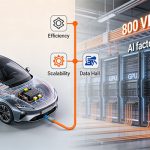
AI data centers are starting to look a lot like high‑performance electric vehicles from a power perspective, and that makes proven 800 VDC interconnect technology from new‑generation EVs a natural building block for the emerging 800 VDC AI factory architecture.
Shared 800 VDC design goals
Both EV drivetrains and next‑gen AI racks must deliver megawatt‑class power with minimal losses, tight packaging, and high reliability. In both cases, moving to 800 VDC sharply cuts current for a given power level, which reduces resistive losses, shrinks cable cross‑section, and enables higher power density without an explosion of copper. AI factories pushing toward 1 MW per rack face exactly the same constraint that 800 V EVs solved: you cannot move that much power efficiently at low voltage like 54 VDC or traditional low‑voltage AC.
Reusing EV interconnect building blocks
Modern EVs already use a mature ecosystem of 800 VDC‑rated components—busbars, high‑voltage connectors, contactors, fuses, and insulation systems—designed for compact, thermally constrained environments such as battery packs and inverters. These same parts and design practices can be adapted to data halls by repackaging them as:
- Rack‑level 800 VDC feed and return busbars instead of large AC PDUs.
- High‑voltage quick‑disconnects and blind‑mate connectors for power shelves and GPU trays, based on EV charge and inverter connectors.
- Integrated 800 VDC distribution harnesses that borrow from EV loom design to manage bend radius, creepage/clearance, and EMI in dense racks.
Because the EV supply chain is already at scale for 800 VDC, using similar interconnect technologies in AI data centers can reduce time‑to‑market and cost while leveraging field‑proven safety and reliability standards.
Aligning with a native 800 VDC rack
NVIDIA’s 800 VDC data center blueprint calls for converting medium‑voltage AC once at the facility boundary, distributing 800 VDC throughout the hall, and then performing a single late‑stage conversion to 12 VDC adjacent to each GPU using high‑ratio converters in architectures like Kyber racks. In this model, the entire in‑rack backbone—from the incoming busway to the final board‑level converter—can reuse EV‑style 800 VDC interconnect practices: laminated busbars for low inductance, compact HV connectors at each power module, and standardized creepage, clearance, and touch‑safe enclosures. The result is a simpler, more reliable DC power train with fewer conversion stages and less white‑space consumed by bulky AC switchgear.
Integrating storage and protection
EV technology also brings proven approaches to integrating high‑energy batteries and fast protection at high voltage, which map directly onto AI factories’ need for multi‑timescale energy storage. AI data centers will increasingly pair 800 VDC backbones with short‑duration capacitive storage near racks and large 800 V‑class BESS at the facility edge to smooth volatile GPU loads. EV‑derived contactors, solid‑state switches, and fault‑current management techniques can be reused to isolate faults quickly, coordinate with grid‑scale protection, and keep 800 VDC distribution safe in a dense compute environment.
By borrowing 800 VDC interconnect technologies already validated on the road, AI data centers can accelerate the shift to native 800 VDC power distribution, cut copper and conversion losses, and build scalable “AI factories” that are both more efficient and easier to deploy at megawatt rack densities.
Jim has executive level experience on both the client and agency sides, with deep skills in strategic business positioning along with creation of hundreds of targeted content pieces. There’s nothing he likes more than mapping out the intersection of new disruptive technologies and their optimal market positioning.